Exhibitions 2026
May 22- September 06, 2026
LU YANG: THE DOKU TRILOGY
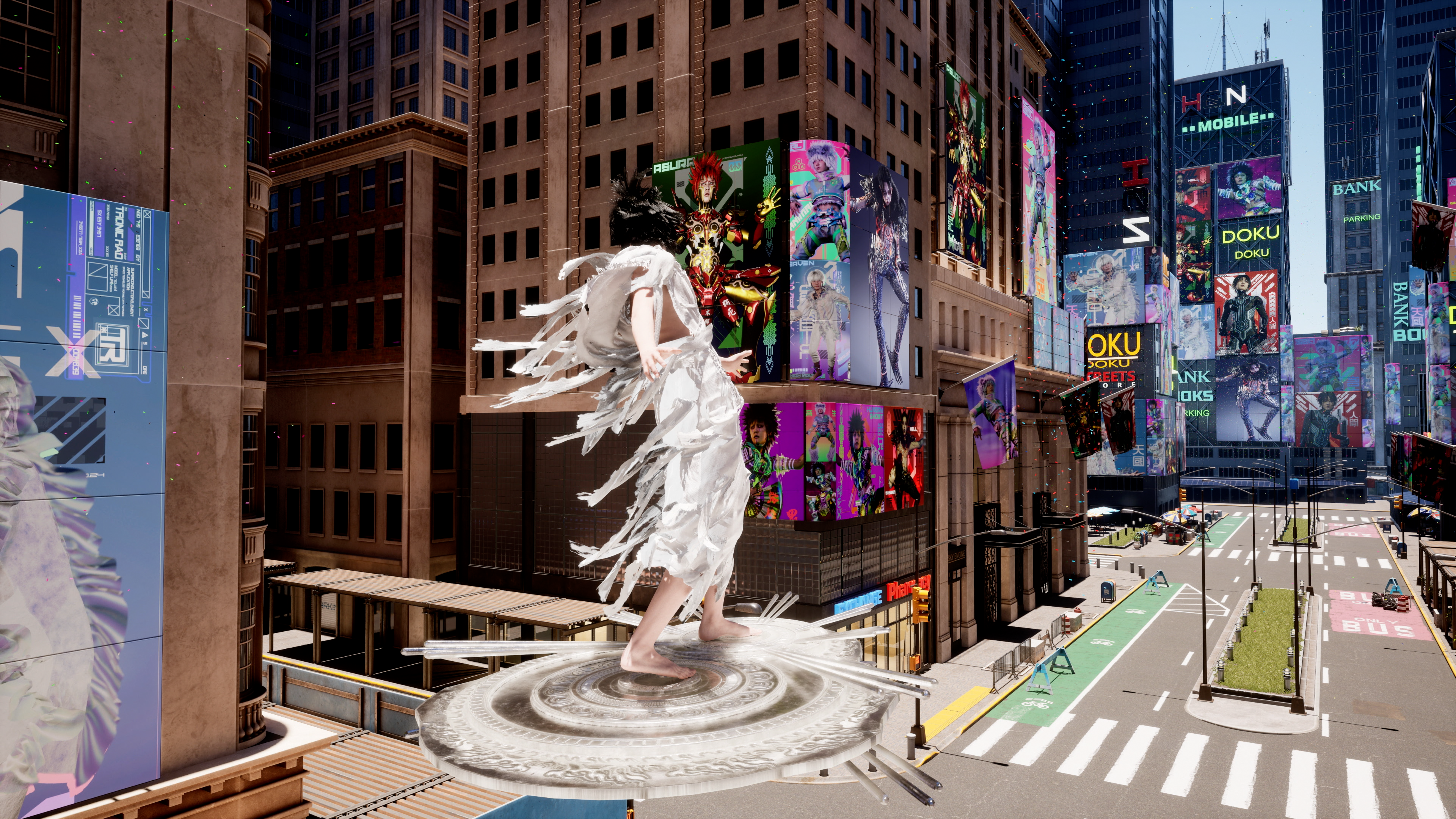
Lu Yang’s ongoing DOKU trilogy of video works (2018–2025) explores the dissolution of selfhood in relation to digital, biological, and spiritual systems. Across DOKU The Self (2022), DOKU The Flow, (2024) and DOKU The Creator (2025), the Chinese artist (*1984 in Shanghai, based in Shanghai/Tokyo) employs video game aesthetics, motion-capture technology, and Buddhist philosophy to interrogate where identity resides when consciousness can be rendered, replicated, and endlessly reborn. Throughout the trilogy an avatar based on the artist’s own likeness is seen to experience or inhabit various realities, ranging from mundane to the utterly fantastic. Inspired by ideas from Yogācāra Buddhism—particularly the concept of ālayavijñāna or “storehouse consciousness”—Lu Yang pictures DOKU not as a stable character but as a flickering assemblage of data, neurons, and spiritual concepts. Altogether, the trilogy asks whether the self, once decomposed into genetic code, brain activity, and algorithmic behavior, can be said to exist at all, or whether it persists only as impermanent patterns cycling through biological and digital networks.
While Vienna Digital Cultures 2026 explores forms of digitally mediated togetherness and individuality under the theme “Alone or Together?”, Lu Yang’s DOKU trilogy poses a more fundamental question, namely: whether the individual doing the connecting or withdrawing is coherent in the first place. If the self is not a stable entity but a flickering assemblage of data, neurons, and karmic residue, then the opposition between solitude and togetherness begins to dissolve at its foundation—you cannot be alone, or together, if there is no fixed “you” to begin with.
Here, Buddhist philosophy and digital culture converge with surprising force: The concept of ālayavijñāna—a storehouse consciousness that accumulates impressions across lifetimes without constituting a fixed soul—offers a pre-modern framework that feels newly legible in an age of persistent data trails, behavioral profiling, and digital afterlives. The DOKU avatar, modelled on the artist’s own likeness yet untethered from any singular body or moment, embodies the condition the festival sets out to examine: circulating continuously, visible yet elusive, present without being locatable. In this sense, THE DOKU TRILOGY suggests that what technology has made newly strange, certain philosophical traditions may have understood all along.
Lu Yang (*1984 in Shanghai, based in Shanghai/Tokyo) is a Chinese artist, whose 3D animations and installations explore fundamental questions of the body and consciousness, spirituality and science, and the limits of being human. Yang gained international recognition through presentations at the Biennale di Venezia, Times Square Arts (NYC), Julia Stoschek Foundation (Düsseldorf), Centre Pompidou (Paris), Louis Vuitton (Paris), the New Museum (NYC), Hamburger Bahnhof (Berlin), Mori Art Museum (Tokyo), Kunsthalle Basel, Fridericianum (Kassel) and Ullens Center for Contemporary Art (Beijing), among others, and is part of major international collections. In 2022, Lu Yang was named “Artist of the Year” by Deutsche Bank.
May 22- September 06, 2026
FABIAN KNECHT: LACHEN IST VERDÄCHTIG (2022–)
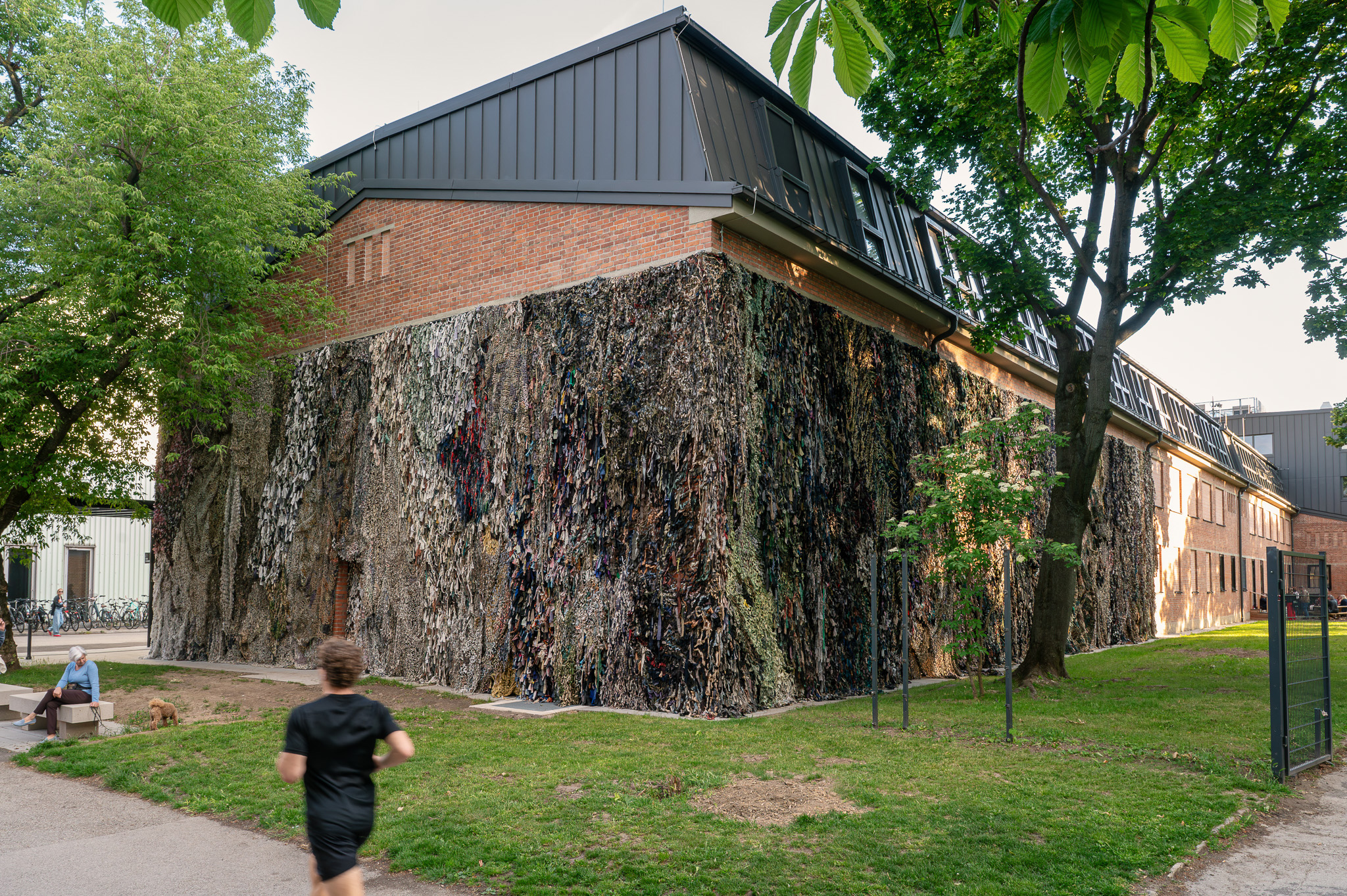
A network of fabric strips, frayed, in earthy green tones, threaded with improvised knots. At first glance, Fabian Knecht’s installation Lachen ist verdächtig (“Laughter is suspicious”) (2022–) appears abstract. However, the work brings a largely unseen form of Ukrainian civilian resistance to FOTO ARSENAL WIEN. Since the beginning of Russia’s full-scale invasion in 2022, hand-knotted camouflage nets have become one of the most widespread expressions of civilian resistance in Ukraine—making vehicles and positions invisible to drone weapons. Knecht collected the nets during 19 humanitarian missions to Ukraine since the start of the war, exchanging them on site for professional military-grade camouflage. Sourced from nearly all regions of the country, the nets vary widely in color, density, pattern, structure, and materiality. Installed together, they form a dense spatial and visual field that speaks to care, resilience, and the blurred boundary between civilian life and warfare. Shown at FOTO ARSENAL WIEN, the work gains an additional resonance: On the grounds of the Arsenal, shaped by military relics, the textile net is set against material testimony of past wars to comment on the present. It shows how resistance to digital-enabled warfare is pursued not only through novel weapons but also collective (analog) labor.
Fabian Knecht (*1980 in Magdeburg, based in Berlin) is a German artist whose work involves radical interventions into space and everyday life, questioning patterns of perception and action as well as social norms and power structures. Knecht studied at the Berlin University of the Arts, the Institute for Spatial Experiments, and the California Institute of the Arts. His works have been exhibited internationally, including at the MSU Museum of Contemporary Art (Zagreb), the Neue Nationalgalerie (Berlin), the Imperial War Museum (London), the Akademie der Künste (Berlin), and the Kunsthalle Mannheim.